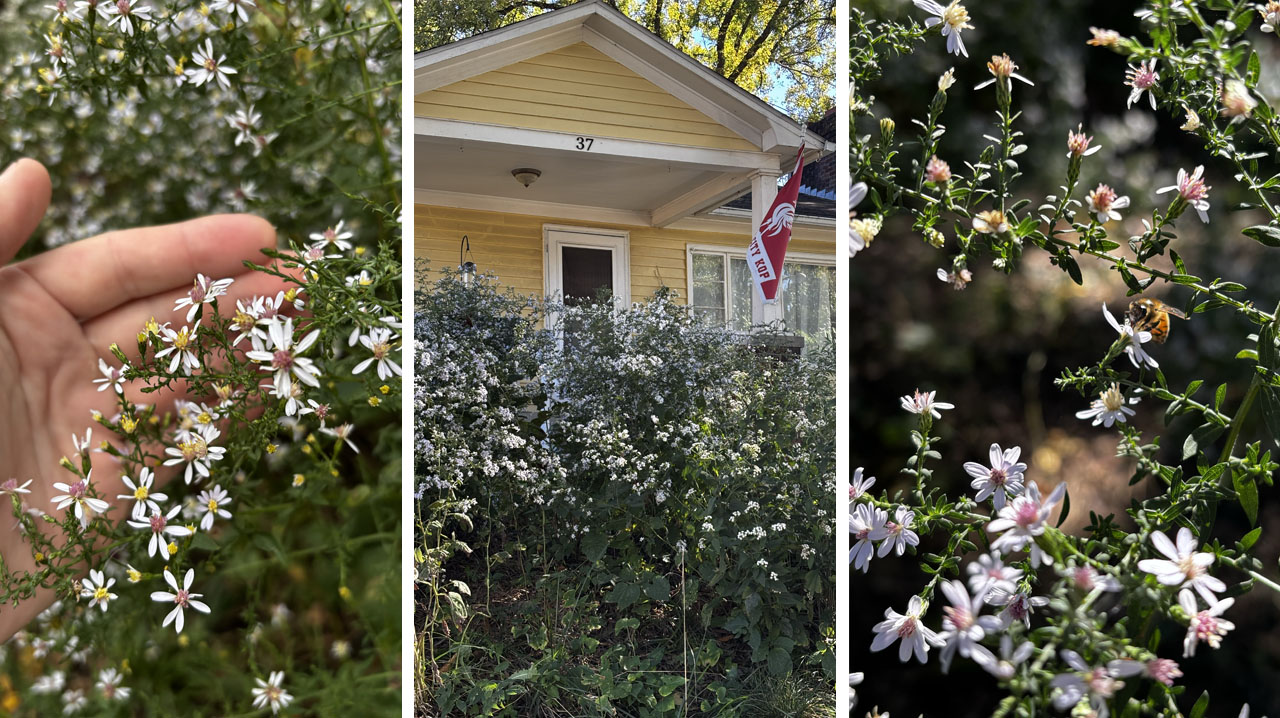
“Whoa, Neighbor – Are You Checkin’ Out My Asters?!”
Article by Chris Cardwell, Deep Roots’ Urban Conservation Program Manager
When I was a high school percussionist, I learned many lessons. The greatest lessons of all, those of pure and patient listening and observation, came from my assignments in later-season orchestra and concert band as an ‘accessory percussionist.’ The quiet kids at the rear of the stage would occasionally throw in a twinkle of wind chimes, a ding of a triangle, or a delicate roll of the suspended cymbal. Each subtle touch was separated by countless measures of rest which could feel like silent eternities. But any devoted classical music enthusiast knows how the song often ends – in a crescendo of power and tone, climbing and billowing into a final, climactic explosion of symphony. The kids at the back of the stage, now finally armed with rolling kettle drums, or pairs of massive bronze crash cymbals, are on full Fortissimo display in this swan song of volume and expression!! Big, big finish! The conductor closes emphatically! Bravo! Bravo! Applause!!
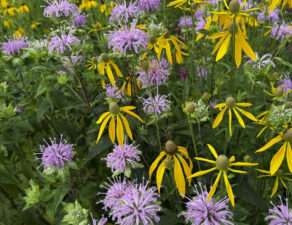
But wait, Chris, isn’t this supposed to be an episode of What’s Blooming Now? Well, yes, of course it is. This is the final installment of WBN for the year, and in my landscape a long-awaited explosion of blooms, like an opus’ grand finale, comes from the Asters. Throughout most of my own densely shaded landscape, wherever I want swaths of nature-supporting monocultures there are solid, massive stands of Drummond’s Aster (Symphyotrichum drummondii), pocked with random and whimsical pillows of White Snakeroot (Ageratina altissima). Like their musical counterparts, October’s asters have waited patiently for months, counting rest after rest in a whisper – “One, 2, 3, 4…and on, and on through summer…168, 2, 3, 4.” And the scruffy green globs that seem to be nothing more than weeds to the untrained eye suddenly transform into a delicate, pale-purple cloud that hovers at waist height, buzzing with every hungry pollinator from every barren property, for blocks around. This is the final display that lights up the herbaceous layer of my wooly, wildlife-supporting landscape.
Though not for gardeners who are faint of heart, this gregarious, 3’ tall plant strikes a tug-of-war balance with the equally assertive Snakeroot. The sheer volume of blooms at this critical point of the year is impressive, especially given the harsh dry, full shade conditions that exist in this “no-man’s-land” part of my property. Thousands of insects, particularly bees, cover every inch of the blooms, whose thick stands of stalks have provided birds and small animals with cover and habitat for months. Deadheading the spent blooms will help to limit its spread.
And that neighbor? Well, I awoke one Saturday in early summer to the familiar mechanical whirring of his weed eater, like clockwork at around 9 a.m. each weekend, only it sounded much closer than most Saturdays. I looked out of my bedroom window to see him ‘generously’ assisting me with some overgrowth on my front slope, dropping two-foot-tall stalks of some seemingly useless weeds! After pouring a cup of coffee and taking an extended moment for diamond breathing, I went to the front door and stepped out to politely interrupt this neighborly, 2-cycle-fueled gesture. I describe to my neighbor the slow, annual development and huge final payoff of the asters. “The as-what’s?” he replied? “As-ters. Just wait until fall, you’ll see what I’m going for.” Little did the good neighbor know the true value of his efforts mimicked herbivory! Often called the Chelsea Chop in our crowd, a good healthy pruning or two (or three) of many native species in late spring and early summer keeps their growth habit tight, and actually encourages more prolific budding, and thus hundreds of more blooms. Eventually.
Fast forward through the season. This past weekend’s outcome, on a surprisingly quiet Saturday morning, was redemptive in a way. A similar pour of coffee and that same step through the front door reveals my neighbors, with nothing left to mow or trim in mid-October, leaning over the picket fence, talking with each other about this “poof” of flowers that just appeared in my front yard. I nod to the pale lavender cloud pouring down the front slope, and call out, “Whoa, neighbors, are you checkin’ out my asters?”
I thought it was funny. Maybe they’ll get it next year?

Write a comment: