Deep Roots
Skip to content
MENUMENU
  • Nature Advisors
  • Gardens
    • Sweet Sixteen Plants
    • Kansas City Keystones
    • Find Plants
    • Plant a Garden
    • Loose Park Native Garden
  • Events
    • View Upcoming Events
    • Habitat Garden Tours
    • Native Plant Sales
    • Guided Nature Experiences
  • Learn How
    • Curious by Nature
    • Plan it Native
    • Discover Native Gardening
    • Beginner/Refresher Series
    • Other Resources
  • Get Involved
    • Plan It Native
    • Jobs
  • About
    • Contact Us
    • Our Story
    • Board of Directors
    • Staff
    • Annual Reports
    • About Native Plants
      • Glossary
  • Shop
  • Donate
 ...

Your Yard’s Place in Nature

Deep Roots Team January 22, 2024

By Stacia Stelk and Denna Nachlinger

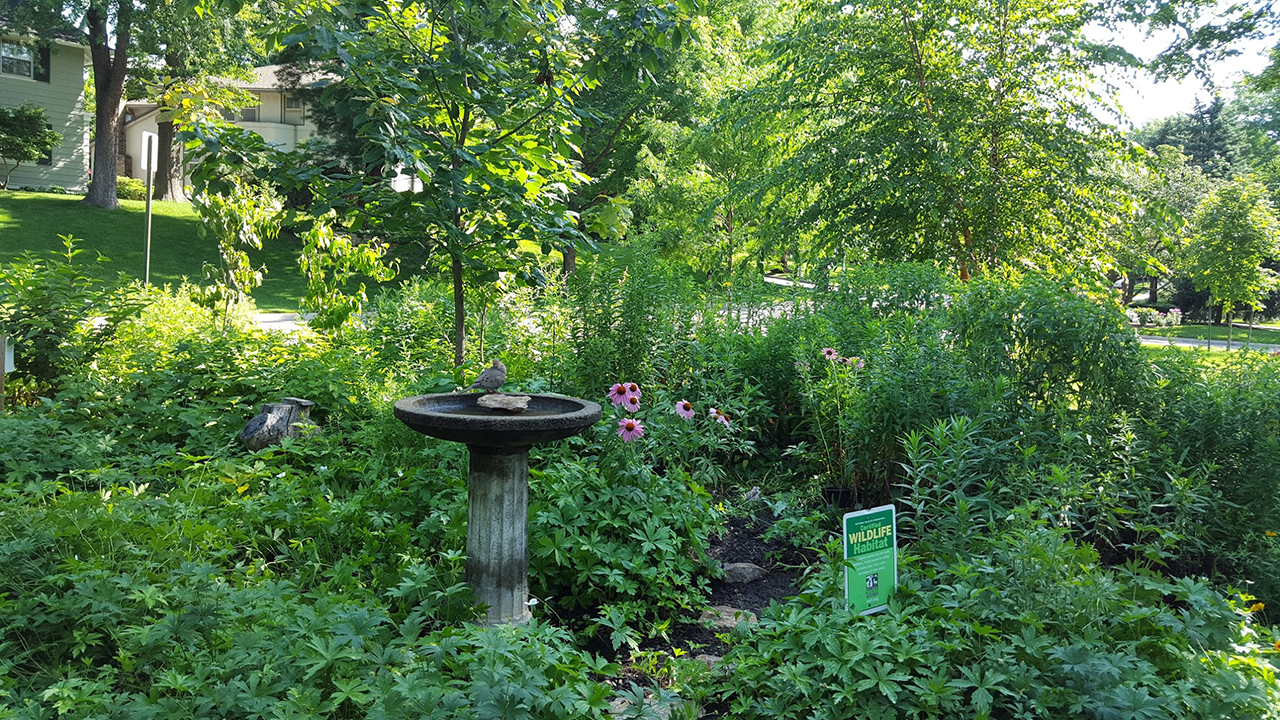
Most of us think of nature as “away” instead of “outside my back door.”  In fact, the outdoor areas where we live are critical parts of our ecosystems.

An ecosystem is a group of organisms interacting with each other and with their environment.  Ecosystems come in all different sizes. All of planet Earth is an ecosystem.  Zooming in, a prairie is an ecosystem. Even a single scoop of soil can be described as an ecosystem. (Did you know that grasslands are the most threatened ecosystem on the planet and least protected?)  An ecosystem consists of all its plants, insects, and other animals interacting with each other and with nonliving things like soil, sunlight, air and water.  All these elements exist in your outdoor spaces, and you are part of that ecosystem too!

Within your ecosystem, food webs describe how your ecosystem’s plants, insects, and other animals get their energy. Specifically, these food webs describe the path where energy flows through the ecosystem. Plants take sunlight and turn it into energy while absorbing water and nutrients from the ground. Insects feed on plants. Birds feed on plants and insects, and so on. If one of these elements is lost, the food web is broken. For example, if we lose milkweed, we lose monarch butterflies because their caterpillars ONLY feed on milkweed.

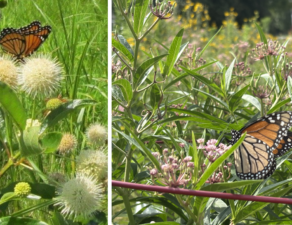
Monarchs and milkweed plants are an excellent example of co-evolution. Co-evolution is the process of evolutionary change that happens as species interact with each other.  This process happens over thousands of generations, which can take thousands of years.  Milkweed evolved a defense system that includes hair on its leaves, sticky sap, and toxins to keep animals from eating it. The monarch evolved and overcame these defenses. The monarchs’ caterpillars are one of the few species that can eat it.  In fact, monarchs not only digest the milkweed toxin, they also retain the toxicity and use it for their own defenses. When a bird eats a monarch caterpillar, it vomits, and never eats a monarch caterpillar again. The monarchs’ evolution is so specific to milkweed plants that its caterpillars cannot eat other plants.  We refer to the milkweed as the monarch’s host plant.

Thriving ecosystems are held together by keystone species. Oak (Quercus) trees and showy goldenrod (Solidago speciosa) are examples of keystone plant species. Both oak trees and goldenrods support hundreds of species of butterflies and moths (Lepidoptra). With butterflies and moths supporting birds and other species, you can see the importance of a keystone plant in this food web and ecosystem. When thinking about hosting a healthy ecosystem in your yard, remember what you plant matters!

This article is the first in a series to help people get started, or improve, their native plant gardening knowledge. Next month, we will talk about site assessment and preparation.

Want a deeper dive to learn more about Your Yard’s Place in Nature? Take a moment and watch episode one of our Beginner/Refresher Garden Webinar Series.  It is a five-part series that will help you understand why native plants are important, how to get started and how to maintain native plant gardens. Over the next few months, we will provide a synopsis of each episode.  You can view the episodes in their entirety on the Beginner/Refresher Series page of our website.
 Category Ask the Experts Native Gardening
RELATED STORIES

 Category Ask the Experts Pollinators

Deep Roots’ June Events Are “Popping”

Above: Pick up more native plants at the upcoming, 3-day, Pop-up Pollinator Plant Sale. Photo…

 Deep Roots Team
May 25, 2026
0 Comments

 Category Ask the Experts Pollinators

An Ode to The Bees

Article by: Maddie Ball, Deep Roots’ Outreach and Education Program Coordinator Above photo: Bee on…

 Deep Roots Team
May 25, 2026
0 Comments

 Category Ask the Experts

BIO 101 Plant Physiology

Article by: Stacia Stelk, Deep Roots’ Executive Director Purple Coneflower (Echinacea purpurea) Photo by Maddie…

 Deep Roots Team
May 25, 2026
0 Comments

 Category Ask the Experts

Opposites Attract

Photos: Bumblebee on Coneflower by Jim Pascoe (left), Bumblebee on Iris by Amanda Gehn (right)…

 Deep Roots Team
April 18, 2026

 Category Ask the Experts Native Gardening

Resident Highlight: Leslie Mark

By Maddie Ball, Deep Roots’ Outreach and Education Program Coordinator Footage and Interviews by: Cydney…

 Deep Roots Team
April 18, 2026

 Category Ask the Experts Native Gardening

De-Lawn and Carry On

By Kay Thomason, Deep Roots’ Outdoor Education Program Coordinator Photos: Cydney Ross, Deep Roots’ Outdoor…

 Deep Roots Team
April 18, 2026

 Category Ask the Experts Native Gardening

Pre-Spring Maintenance

By Maddie Ball, Deep Roots’ Outreach and Education Program Coordinator and Cydney Ross, Deep Roots’…

 Deep Roots Team
March 21, 2026

 Category Ask the Experts

Ask the Experts: Getting Started and Planting for Reptiles

By Deep Roots Team Pictured above: Residential planting photographed by Cydney Ross Hello readers, and…

 Deep Roots Team
March 21, 2026

Deep Roots KC

WHAT YOU PLANT MATTERS

Deep Roots is a collective impact organization of multi-sector Partners. Together with our Partners, we work to increase native plant landscapes. Our mission is to encourage the appreciation, conservation, and use of native plants in the heartland through educating, collaborating, and facilitating the planting of regenerative native landscapes that are essential for a healthy planet.

Sign up for our Newsletter

To stay up to date with announcements and news about native plants, as well as our Plan It Native Conference, please sign up for our newsletter at this link.


Quick Links

Contact Us
Glossary
Donate
Jobs

Instagram Feed

deeprootskc

Check out these Deep Roots staff picks! 🤩💕🌼 All o Check out these Deep Roots staff picks! 🤩💕🌼

All of these native plants will be available at our three day Pop-up Pollinator Plant Sale which begins TODAY! Come by the Anita B. Gorman Conservation Discovery Center between 12PM and 6PM to take these plants home with you. 🏡🪴

#deeprootskc
#nativeplants #whatyouplantmatters #kansascity
#plantsale
Find the Deep Roots program for you! This week we Find the Deep Roots program for you! This week we have a parade of events all in the name of native plants and residential native gardening🌻🌼🪻

Visit the Deep Roots upcoming events webpage to learn more about each of these opportunities to get involved with Deep Roots! 

#deeprootskc #nativeplants #whatyouplantmatters #kansascity #nativeplantsale
Come volunteer with Deep Roots at our three-day, P Come volunteer with Deep Roots at our three-day, Pop-up Pollinator Plant Sale and June Habitat Garden Tour! 🌳🌻🪴

Meet new people, learn more about Deep Roots programs, and spend a joyous few hours spreading native plant love with KC residents. Follow the links in our bio to learn more and sign up to volunteer!

Pop-up Pollinator Plant Sale: June 4-6 at Anita B. Gorman Discovery Center
Habitat Garden Tour: June 6th in Midtown

#nativeplants #volunteer #kansascity #deeprootskc #whatyouplantmatters
🚫DON'T DOOM THE BLOOM🚫 WOWEE, this Shawnee Missio 🚫DON'T DOOM THE BLOOM🚫

WOWEE, this Shawnee Mission Park superbloom is absolutely stunning. This site would not look how it does now if park visitors trampled the plants or picked the flowers. Be a respectful explorer and practice observing the natural phenomenons near you instead of taking from them. 😍🌼

Follow the Johnson County Parks and Recreation website in our bio to learn more about park practices and discover the many trails open to the public.

To visit this Foxglove Beardtongue superbloom at Shawnee Mission Park go to the Deep Roots Guided Nature Experiences page, also linked in our bio. 

#dontdoomthebloom #johnsoncountyks #shawneemissionpark #deeprootskc #nativeplants
It's Chelsea Choppin' time! This is a great mainte It's Chelsea Choppin' time! This is a great maintenance practice you can use in your garden to keep your taller plants short and encourage them to produce more blooms🪻🌷🌻

#chelseachop #deeprootskc #gardenmaintenance #nativeplants
We are getting closer and closer to our three day We are getting closer and closer to our three day Pop-up Pollinator Plant Sale! Just when you thought it couldn't get any better, check out the native tree species that will be up for grabs. Help restore the urban canopy with native hardwoods 🌳🍂

Sale times: 
Thursday & Friday
12 p.m. – 6 p.m.
Saturday
9 a.m. – 1 p.m.

Pre-sale is open until May 28th. All pre-sale plant orders must be picked up at the sale location on the first day (June 4th). Native trees are not open for pre-sale. Follow the link in our bio for pre-sale. 

Photos from Missouri Botanical Garden

#kansascity #deeprootskc #NativePlantSale #WhatYouPlantMatters
Tommorow at noon, tune in to Curious By Nature to Tommorow at noon, tune in to Curious By Nature to learn more about using plant sociability as a way determine perfect plant pairings 🌸🌻 

Join us for the live show to ask Cydney your native gardening questions! Use the Curious By Nature link in our bio to register for the live show today. 

#CuriousbyNature #deeprootskc #whatyouplantmatters #plantpairings
Don't let the ticks get you down ❌ Here are some Don't let the ticks get you down ❌

Here are some quick and easy things you can do to make your outdoor exploring as tick free as possible! Once your pants are tucked and you're ready to go, check out the many Johnson County parks and trails open to the public. Visit the Johnson County Parks and Recreation District website to learn more about where and how you can get outdoors while the sun is shining☀️🌻🌳

WARNING: When using permethrin, please read all warnings and follow the instructions written on the label. Use this spray in an outdoor area and keep away from your pets. Permethrin is highly toxic to pets, specifically cats, so be sure to let all outdoor gear and clothing dry before bringing it back into your home. 

#tickprevention #johnsoncounty #deeprootskc #kansascity
Round two of Habitat Garden Tours is coming up! 🐝🌸 Round two of Habitat Garden Tours is coming up! 🐝🌸

On June 6th, join us as we explore three residential native gardens in Midtown. We are showcasing gardens that heal, inspire, support wildlife, and are just nice to look at! More information about each garden and the day of event can be found on our Habitat Garden Tour webpage. 

This tour is on the last day of our Pop-up Pollinator Plant sale - a three day plant sale hosted by Deep Roots at the Anita B. Gorman Conservation Discovery Center. Find a plant that you like on the tours and then take that plant home with you on the same day. 🌱🏡

We are looking for volunteer support both at the three day plant sale and at the Habitat Garden Tours! Volunteering is a great way to meet new people, learn more about our programs and mission, and also grants you a FREE Habitat Garden Tour ticket. Learn more on the Habitat Garden Tour or Native Plant Sale pages found in our bio!

#deeprootskc #nativeplants #whatyouplantmatters #habitatgardentours #kansascity
Follow on Instagram
P.O. Box 32131 Kansas City, Missouri 64171 816-301-7545 hello@deeprootskc.org

© 2019 Deep Roots KC  |  Website by Red River Valley Design

