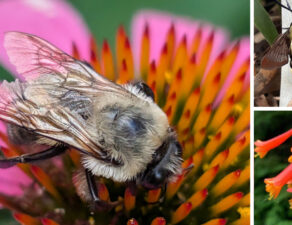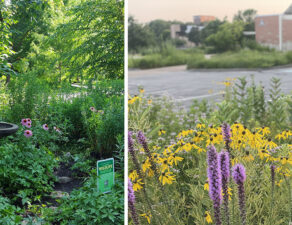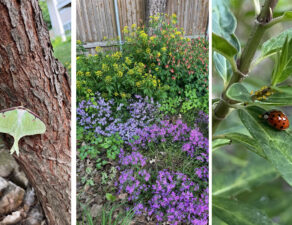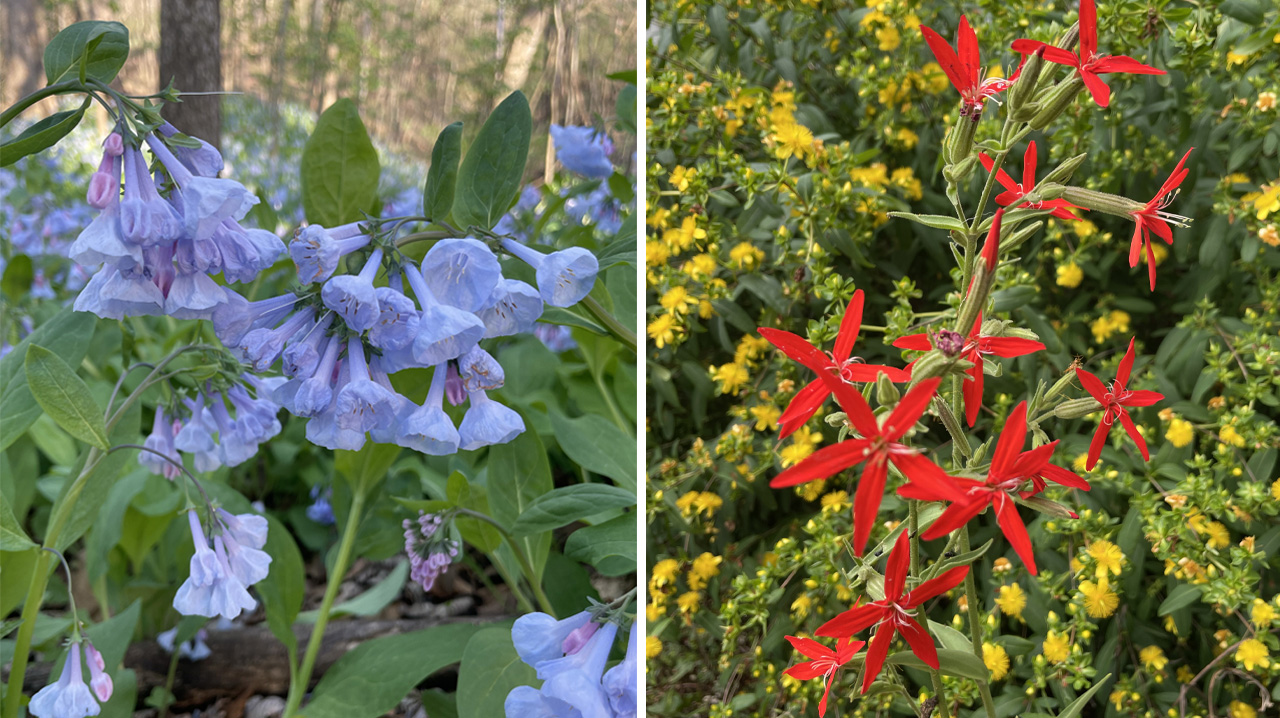
Pictured above: (L-R) Virginia Bluebells (Mertensia virginica). Royal Catchfly (Silene regia) and Shrubby St. John’s Wort (Hypericum prolificum). Photographs by Cydney Ross.
Story by Cydney Ross, Deep Roots’ Outdoor Education Manager
It’s a complicated topic, but as a gardener and artist, I’m captivated by natural pigments seen in nature. Between making pigments from naturally foraged materials and reading numerous articles on the topic, here’s what I’ve come to understand. Color comes from light which is comprised of all the colors of the rainbow: red, orange, yellow, green, blue, indigo, and violet. When light hits an object, color wavelengths are either absorbed or reflected. Color perception has to do with the light reflected on objects at a molecular level. When we look at an object, our brain works in unison with our eyes to translate those wavelengths of light into perceived color. For example, the petals on Lanceleaf Coreopsis (Coreopsis lanceolata) absorb all light colors except yellow, which is reflected to our eyes. If something reflects all light wavelengths, it appears white and if it absorbs all, it appears black.
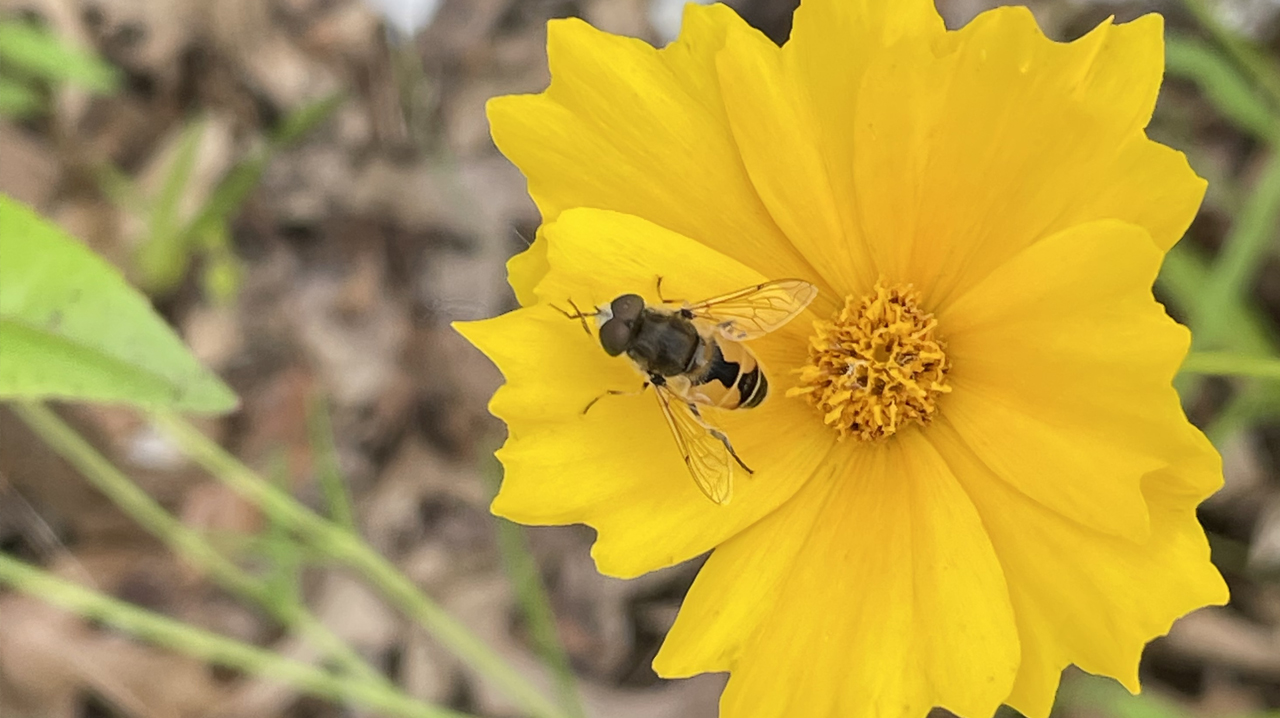
Pictured above: Bee-mimicking Fly on Lanceleaf Coreopsis (Coreopsis lanceolata). Photograph by Cydney Ross.
Color can be categorized as pigment-based or structural. Pigments are physical, material substances that selectively absorb light. Structural color is based on the scattering of light due to physical molecular structures. The easiest way to think about this is to compare how a crushed berry stains your hands (pigment) versus looking at birds whose color shifts with movement (structural). Imagine a European Starling (Sturnus vulgaris). Though they initially appear black, as you move around, you’ll see other colors, like an oil slick. This distinction becomes important when we think about the color blue.
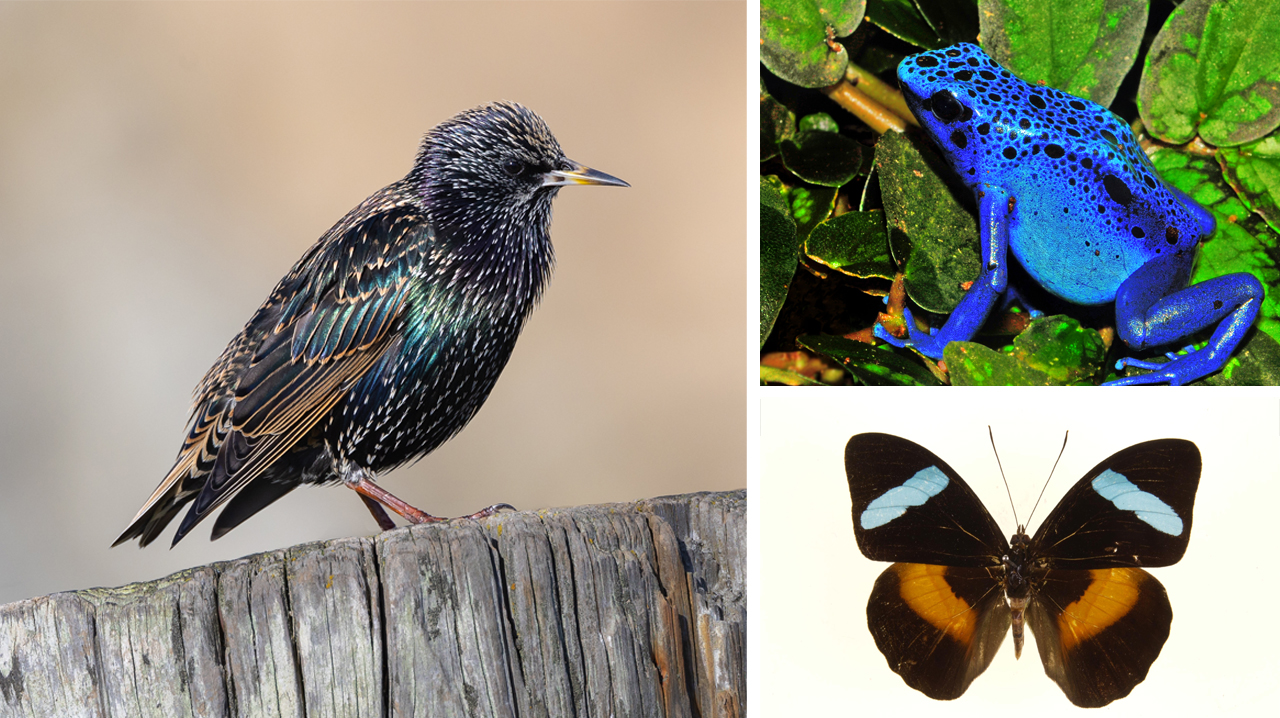
Pictured above: European Starling (Sturnus vulgaris). Photograph by Frank Schulenburg via Wikimedia Commons; Blue Poison Dart Frog (Dendrobates tinctorius azureus). Photograph by Michael Gäbler via Wikimedia Commons; Olive-wing Butterfly (Nessaea obrinus). Photograph by Notafly via Wikimedia Commons.
Typically, blue is made from microscopic physical structures that interfere with refracted light waves and appear blue. In the example of birds, no feathers have blue pigment. Instead, it’s the scattering light that creates a vibrant blue appearance. As you shift around a blue bird, you may notice it looks like a hologram – that’s a clue for structural color. Blue pigment is rare because it requires complex chemistry and is energetically expensive for organisms to create. Of course, there are always exceptions to the rule. Both the Olive-Wing Butterfly (Nessaea obrinus) and Blue Poison Dart Frog (Dendrobates tinctorius azureus) have true blue pigments which are especially uncommon in the animal kingdom. Another example of blue phenomenon is known as Rayleigh scattering. The scattering of molecules in the air tend to reflect blue wave-lengths rather than red, which is responsible for our blue sky.
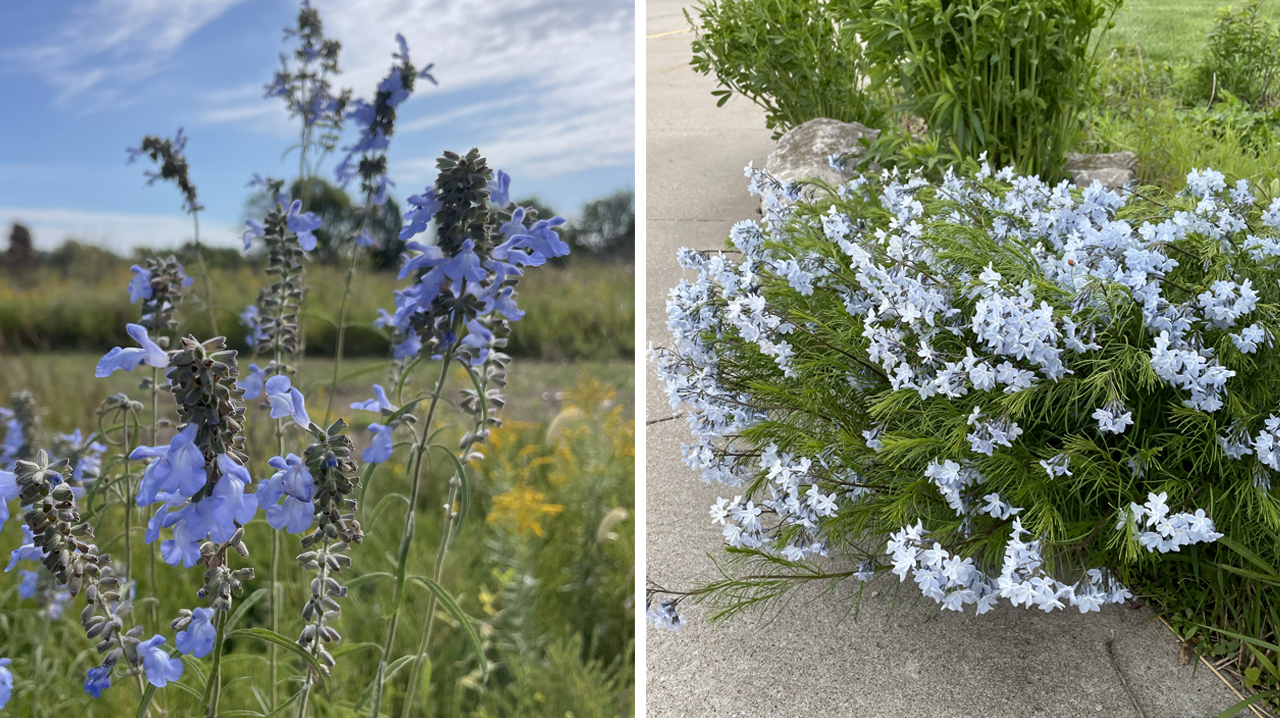
Pictured above: Blue Sage (Salvia azura). Photograph by Matt Garrett; Fringed Bluestar (Amsonia ciliata var. filifolia). Photograph by Cydney Ross.
Flower petals are usually pigment-based and achieve their color as an artist would mix colors on a palette. There are two main pigment types, anthocyanins (red, purple, and blue) and carotenoids (yellow, red, and orange). According to the University of California Botanical Garden at Berkeley, fewer than 10 percent of flowers on Earth are blue. If a flower appears blue, it means the pigment has absorbed the red part of the visible spectrum. Blue will always appear more violet than true blue because of that remaining red in the chemical composition is still present. Blue flowers can also occur if there are unstable pH conditions – think of how folks turn non-native Hydrangeas blue by making their soils more acidic.
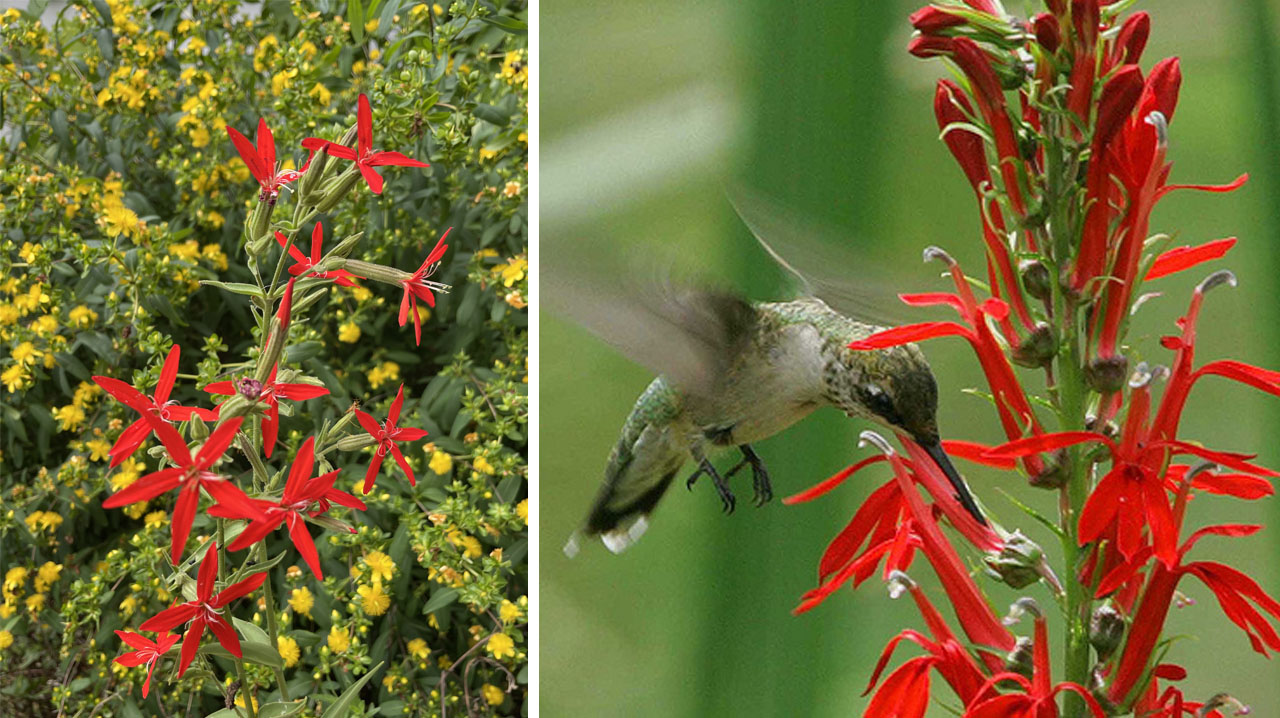
Pictured above: Royal Catchfly and Shrubby St. John’s Wort (left); Ruby-throated Hummingbird (Archilochus colubris) on Cardinal Flower (Lobelia cardinalis). Photograph by Bill Buchanan for US Fish and Wildlife Service.
In the Midwest you may notice we don’t have an abundance of red flowers. Red in itself isn’t a rare pigment like the color blue. Instead, it has to do with how our plants evolved alongside wildlife for millennia. The physical traits of flowers have adapted to attract pollinators is known as “Pollinator Syndrome.” In Kansas City we get migrating Ruby-Throated Hummingbirds (Archilochus colubris) which are famously attracted to red tubular flowers. But the majority of our pollinators here are insects like bees, flies, wasps, moths and butterflies who don’t see red as vividly. They prefer to taste other colors of the rainbow, so to speak. It’s pretty cool to think how pollinator preference has heavily influenced the type of flowers we see in our landscapes!
Blue-ish and Red Midwestern Native Plants*
Bluestar (Amsonia species)
Blue False Indigo (Baptisia australis)
Blue-eyed Mary (Collinsia verna)
Closed Bottle Gentian (Gentiana andrewsii)
Virginia Bluebells (Mertensia virginica)
Sand Phlox (Phlox bifida)
Blue Sage (Salvia azurea)
Prairie Blue-eyed Grass (Sisyrinchium campestre)
Red Buckeye (Aesculus pavia)
Cross Vine (Bignonia capreolata)
Trumpet Vine (Campsis radicans)
Blanket Flower (Gaillardia pulchella)
Cardinal Flower (Lobelia cardinalis)
Coral Honeysuckle (Lonicera sempervirens)
Royal Catchfly (Silene regia)
Fire Pink (Silene virginica)
* This is a non-exhaustive list. Don’t forget to determine “right plant, right place, right purpose” before adding gregarious species to your garden!
Additional resources:
Pantone – How do we see colour?
In Defense of Plants – Blue?
Journal of Evolutionary Biology – Why are red flowers so rare? Testing the macroevolutionary causes of tippiness