Article by Kay Thomason, Deep Roots’ Outdoor Education and Outreach Program Coordinator
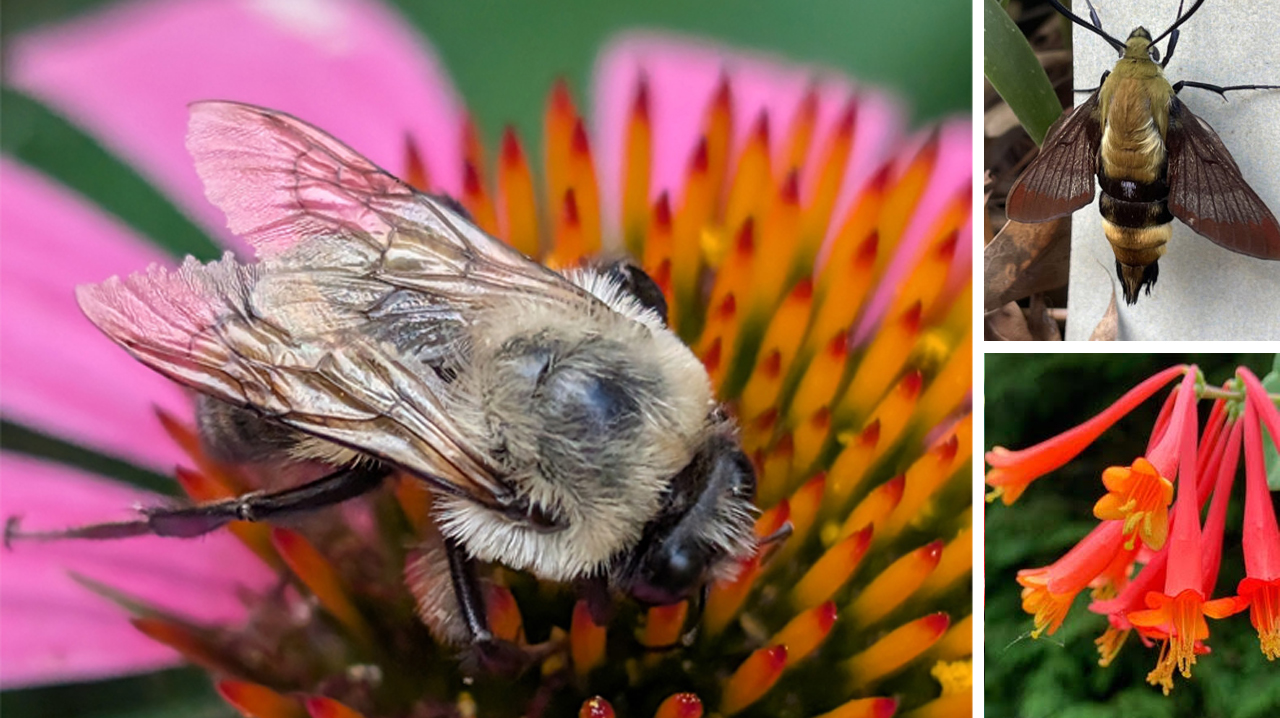
Photo credits: Bee on coneflower– Sally Urdang; Snowberry clearwing moth – Cydney Ross; Coral Honeysuckle – Missouri Botanical Gardens
Ever wonder why hummingbirds prefer red flowers? Or why some plants in your garden attract bees better than others? This is due to a scientific concept called pollination syndrome. The word syndrome is often associated with illnesses that have a specific combination of symptoms, but its definition here signifies the specific combination of evolved traits perfect for attracting a plant’s ideal pollinator. Pollination syndrome describes how floral traits such as color, shape, scent, nectar type, and timing have evolved in response to the preferences and behaviors of specific groups of pollinators. This concept reveals the discovered patterns in nature that inform how plants and pollinators co-evolved. Three clear examples where we see this co-evolution are in bee, hummingbird, and moth pollination.
1. Bee Pollination
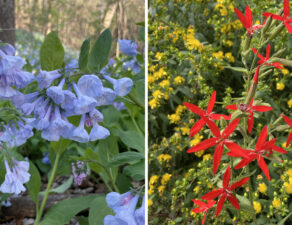
Bee-pollinated flowers are common because bees actively search for both nectar and pollen. These plants typically show blue, violet, yellow, or white colors, along with UV nectar guides visible only to bees. Flowers are often open or moderately deep with landing platforms that suit the way bees perch and crawl. Their scents are usually sweet or lightly herbal, and nectar is moderately concentrated. As bees move through a blossom, the flower’s anthers and stigma are positioned to contact the bee’s fuzzy body, ensuring efficient pollen transfer. Familiar examples include Asters (Symphyotrichum sp.), Coneflowers (Echinacea sp.), and fruit blossoms.
2. Hummingbird Pollination
Hummingbird-targeting flowers reflect the sensory world of birds: bright, red or orange colors that stand out in foliage but little to no scent. Other pollinators like bees and flies cannot see the color red, so the hummingbird knows these flowers are a reliable source of nectar with little competition. The blooms are typically tubular, matching the shape of a hummingbird’s long bill and hovering feeding style. These flowers produce abundant, high-sugar nectar to fuel the birds’ rapid metabolism. When a hummingbird feeds, its face and throat brush against the flower’s reproductive parts, transferring pollen between blooms. Plants such as Cardinal Flower (Lobelia cardinalis), Red Buckeye (Aesculus pavia),and Coral Honeysuckle (Lonicera sempervirens) show this syndrome clearly.
3. Moth Pollination
Moth-pollinated flowers are adapted to the sensory world and nighttime behavior of moths. Because many moths are active at dusk or in darkness, these flowers are often white or pale-colored. They typically release a strong, sweet, or spicy fragrance timed perfectly to when moths begin foraging. There are two broad patterns with moth pollination. Large, tubular flowers held away from the plant allow fast-flying moths like the snowberry clearwing moth (Hemaris diffinis) to hover while sipping nectar. Flowers like White Snakeroot (Ageratina altissima) and Spider Lily (Hymenocallis occidentalis) are in that category. In contrast, flowers that are smaller and clustered together allow for easier landing spaces for smaller moths.
There are many reasons why a plant would want to target a specific pollinator. Pollination syndrome reduces competition and therefore the pollinator it evolved for is more likely to visit. By focusing on one group of pollinators that fit their need, plants can reduce the chance of attracting pollinators that waste their pollen without transferring it effectively.
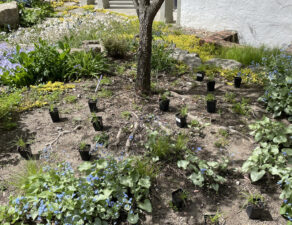
This is why planting native plants that exhibit clear pollination syndromes is so important. Native species have evolved alongside local pollinators, meaning their colors, scents, bloom times, and flower structures are already perfectly matched to the insects, birds, or moths that rely on them. By choosing these well-adapted plants, gardeners help sustain efficient pollination networks and support healthier, more resilient ecosystems.