By Maddie Ball, Deep Roots’ Outreach and Education Program Coordinator
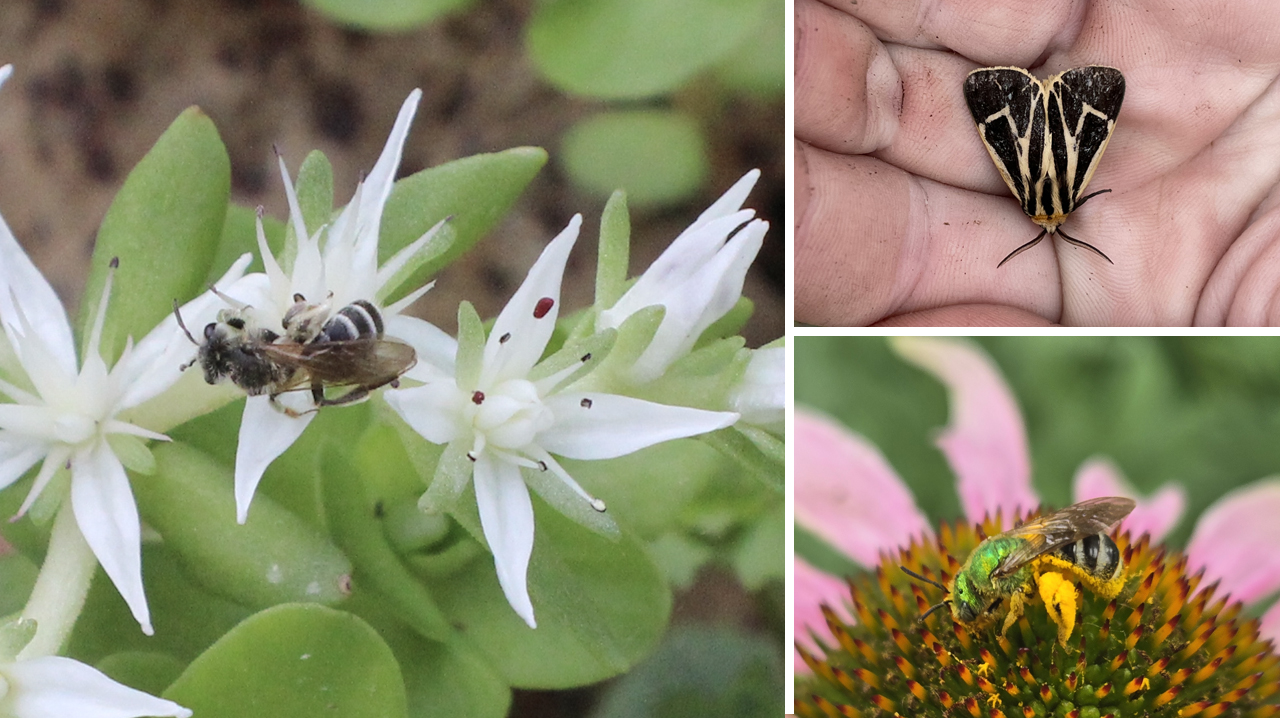
Pictured Above: An assortment of insects including a bicolored striped sweat bee (Agapostemon virescens) (bottom right), nason’s mining bee (Andrena nasonii) (on left), and an Apantesis moth (top right). Photo credits: Ken Plautz, Cydney Ross
Since joining Deep Roots and diving into the native plants and ecosystems of Kansas City, my hike times have tripled. As a birder, I already have to pause every 15 steps to look up and find the source of the new song in the layered avian chorus. Now I find myself additionally stopping to identify every plant I don’t recognize. Through spending more time looking at the ground, my bird observation skills have translated to a new world; one so brilliant and otherworldly, dwelling right at my feet. The world of bugs! I have only scratched the surface of entomology, but with every new discovery, I fall more in love with bugging (the insect version of birding)!
Okay, so ‘bugging’ is not the right term, but ‘bugwatching’ is absolutely a thing you can and should do! All you need is a knack for curiosity and an eye for subtle movements. The insect world is dense. If you think 2,000 North American bird species is a lot to take on, try 91,000 known insect species (plus the thousands of estimated undiscovered species). I find it best to focus on one group at a time and for me, the gateway was wasps.
Surprised? Me too. All I knew about wasps a few months ago was that they made me nervous. That was until I listened to a podcast episode that completely spun my head around: “Spheksology (WASPS) with EricEaton” from the Ologies podcast with Alie Ward.
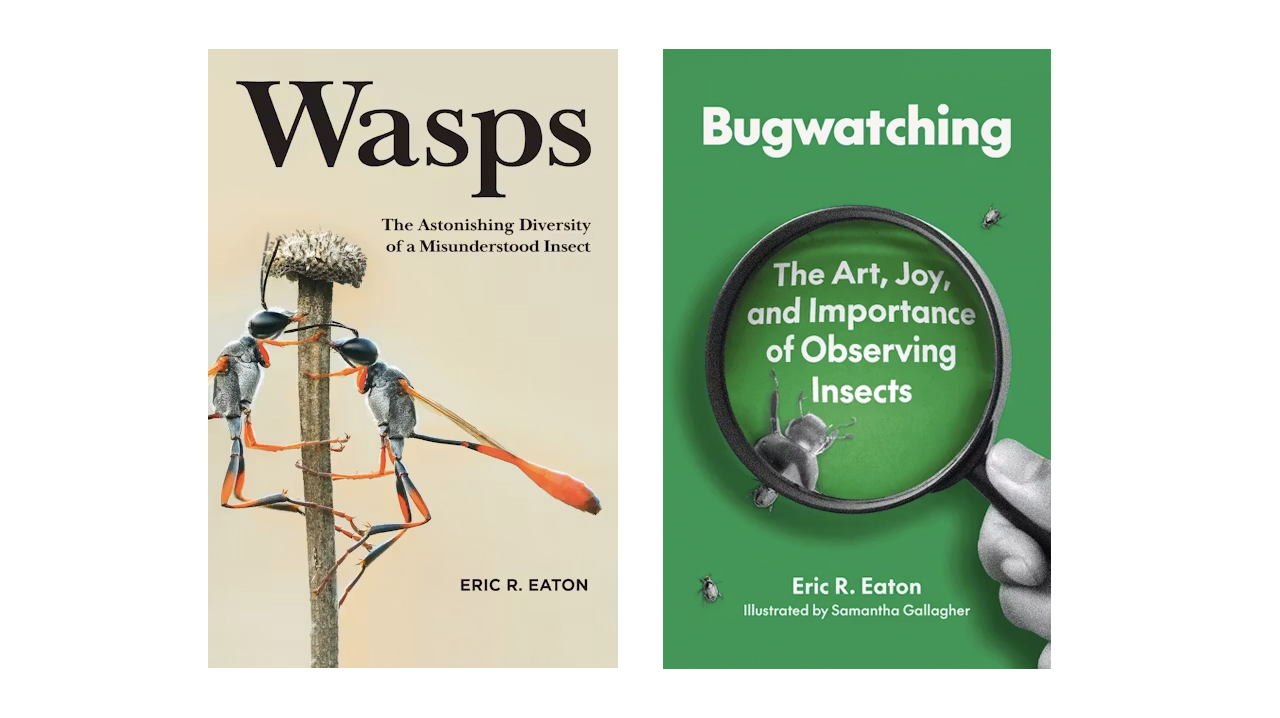
Two books written by entomologist and Plan it Native speaker Eric Eaton
Eric Eaton, professional entomologist and author of Wasps: The Astonishing Diversity of a Misunderstood Insect and Bugwatching: The Art, Joy, and Importance of Observing Insects, shared on the podcast that a very small fraction of wasp species are capable of stinging. Most species are solitary, non-stinging wasps. The stinger evolved from the ovipositor (female egg laying organ) and still serves as such for those non-stinging species. This is also why only female wasps have stingers!
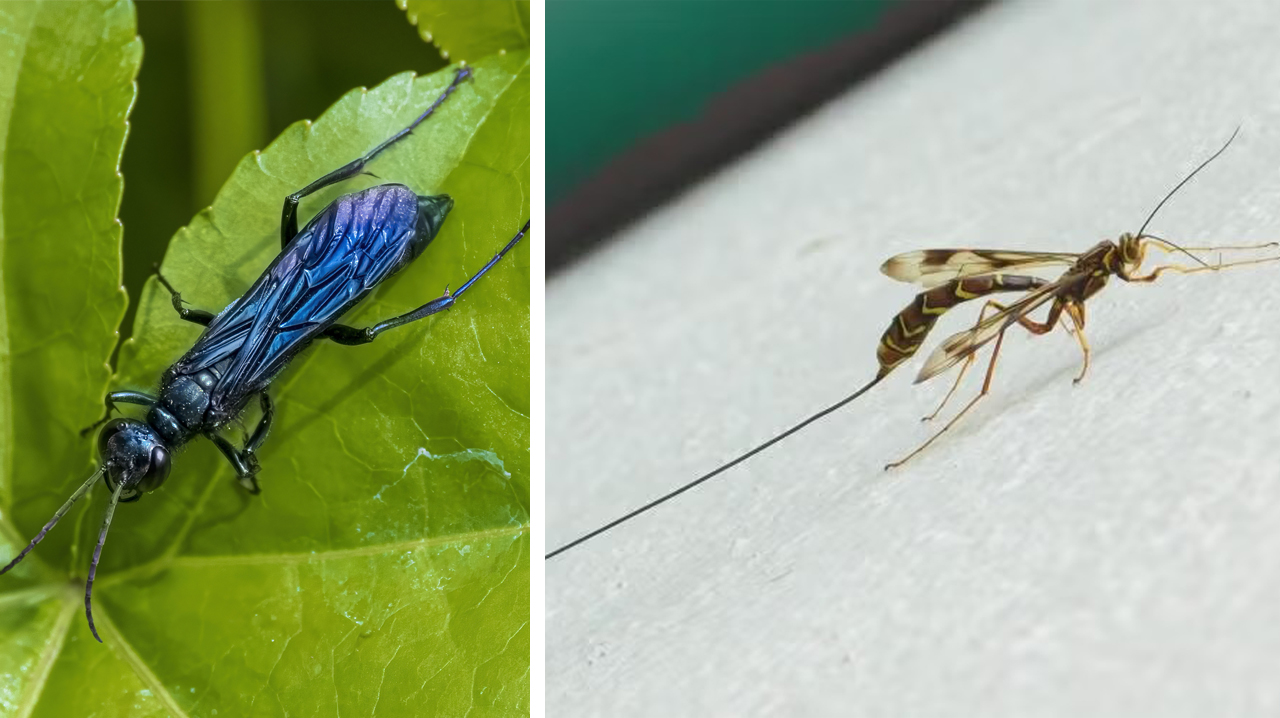
The stunning, half inch blue mud dauber (Chalybion californicum) on the left is a solitary wasp which will only sting if harassed. On the other hand, the long-tailed giant ichneumon wasp (Megarhyssa macrurus
Whether or not a wasp has a stinger is one way to determine their sex, but if you prefer to keep your distance, watching a wasp’s behavior in your garden can be quite informative. Female wasps build nests, forage and hunt for food, and of course lay the eggs. Male wasps have a shorter lifespan and are typically only around for mating. So, if you happen upon a wasp lollygagging around your flowers, that is more than likely a male who has the time to do so. And yes, they are pollinators! Wasp larvae need a lot of protein to grow and so consume their insect host provided by their mom. Adult wasps, however, no longer consume protein and instead rely on nectar, sap, and fruit juices. Therefore, a hungry wasp visiting multiple flowers assists in pollen dispersal. There is also the pollen wasp (Pseudomasaris vespoides) whose larvae only consume pollen, which I imagine is easier to hunt for than a host insect!
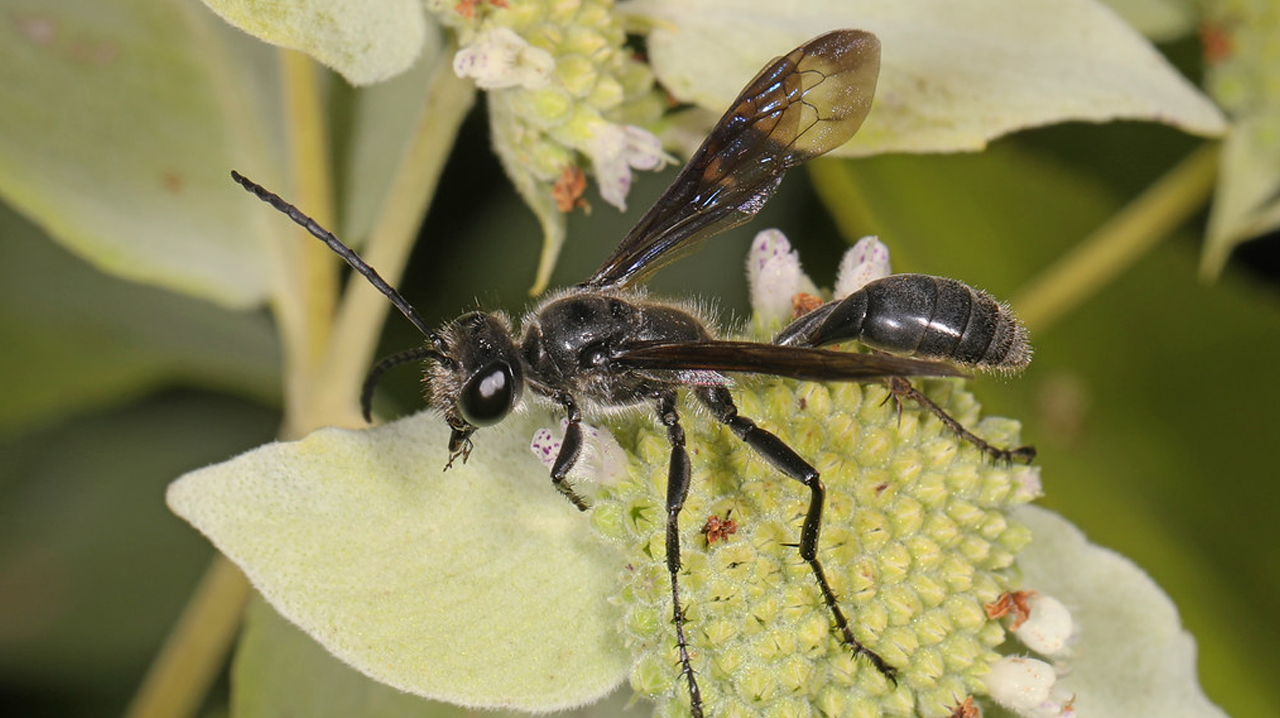
A mexican grass-carrying wasp photographed by Judy Gallagher courtesy of Wikipedia creative commons
At such a small size (at times, smaller than a gnat), the intricacy of their evolved hunting styles and habits is remarkable. Each new species I learn about I am impressed by and with each new factoid I feel more comfortable welcoming wasps to my yard. After all, these are beneficial insects that will keep pest numbers in check and pollinate my flowers. All this learning led to an afternoon of bugwatching where I was entertained for an hour by a female mexican grass-carrying wasp (Isodontia mexicana) flying back and forth, carrying a blade or two of grass at a time into a cavity of the table on my porch!
The man responsible for my new love of wasps, Eric Eaton, will be speaking at our upcoming native plant conference, Plan it Native. His presentation, titled “Beyond Bees and Butterflies: Embracing and Conserving Local Insects” will be sure to help us all care for and appreciate the complexity of the bug world.
Visit planitnative.org to register and learn more about other speakers to expect at this conference!

Black Cherry Sponsors




Prairie Willow Sponsors













Sugar Maple Sponsors




Might your organization be interested in sponsoring Plan It Native 2026? Click here for more information.